Tuesday, May 29, 2012

The National Lying Program

There is a new Ad out from a Romney Super-pac, once again with a perfect example of why we need full disclosure in our political system, so we know who to hold responsible for outright lies and other misconduct.

A recent ad takes President Obama to task for a failed energy project referred to as "Solyndra", the name of a solar energy startup.

Solyndra was given federal loan guarantees in an attempt to boost the nations' output in solar energy. The company failed, costing the US taxpayer millions of dollars.

These are the broad-strokes. The GOP is now trying to blame the Solyndra project on President Obama, and to spin the story as if the company's private investors were somehow an 'Obama favorite' and so got a 'handout'.

Yet in truth, the Solyndra project was started by President Bush, and handed over to President Obama to either kill or move forward. Far from being "rushed through" to benefit "Obama's favorites", the GOP lawmakers were pushing for the deal, along with many others, to move forward more quickly to get stimulus money into the economy.

It's important to note that it wasn't a bad decision by President Bush, although the company did eventually fail due to the 'Great Recession' and subsequent drop in the price of solar photovoltaic cells (PVs) . Bush certainly had the right idea to subsidize US green and alternate energy technologies, this type of investment often returns far more than their cost in direct dollars to the US economy, not to mention as a way to create jobs in a burgeoning indutry and keep the USA conpetitive n the world energy market.

Here are some excerpts from Think Progress' article of September, 2011.

" Bush Administration Advanced Solyndra Loan Guarantee for Two Years, Media Blow the Story"

by Stephen Lacey and Richard Caperton
It’s often claimed that the Solyndra loan guarantee was “rushed through” by the Obama Administration for political reasons. In fact, the Solyndra loan guarantee was a multi-year process that the Bush Administration launched in 2007.
You’d never know from the media coverage that:
  1. The Bush team tried to conditionally approve the Solyndra loan just before President Obama took office.
  2. The company’s backers included private investors who had diverse political interests.
  3. The loan comprises just 1.3% of DOE’s overall loan portfolio. To date, Solyndra is the only loan that’s known to be troubled.
Because one of the Solyndra investors, Argonaut Venture Capital, is funded by George Kaiser — a man who donated money to the Obama campaign — the loan guarantee has been attacked as being political in nature. What critics don’t mention is that one of the earliest and largest investors, Madrone Capital Partners, is funded by the family that started Wal-Mart, the Waltons, who have donated millions of dollars to Republican candidates over the years.


To set the record straight, Climate Progress is publishing this timeline — verified by Department of Energy officials — that shows how the loan guarantee came together under both administrations. In fact, rather than rushing the loan for Solyndra through, the Obama Administration restructured the original Bush-era deal to further protect the taxpayers’ investment:

May 2005: Just as a global silicon shortage begins driving up prices of solar photovoltaics [PV], Solyndra is founded to provide a cost-competitive alternative to silicon-based panels.
July 2005: The Bush Administration signs the Energy Policy Act of 2005 into law, creating the 1703 loan guarantee program.
...
December 2006: Solyndra Applies for a Loan Guarantee under the 1703 program.
Late 2007: Loan guarantee program is funded. Solyndra was one of 16 clean-tech companies deemed ready to move forward in the due diligence process. The Bush Administration DOE moves forward to develop a conditional commitment.
October 2008: Then Solyndra CEO Chris Gronet touted reasons for building in Silicon Valley and noted that the “company’s second factory also will be built in Fremont, since a Department of Energy loan guarantee mandates a U.S. location.”
...
January 2009: In an effort to show it has done something to support renewable energy, the Bush Administration tries to take Solyndra before a DOE credit review committee before President Obama is inaugurated...
         March 2009: The credit committee approves the strengthened
          loan application...(with more consumer protections)
June 2009: As more silicon production facilities come online while demand for PV wavers due to the economic slowdown, silicon prices start to drop.Between June of 2009 and August of 2011, PV prices drop more than 50%...
...

November 2010: Solyndra closes an older manufacturing facility and concentrates operations at Fab 2, the plant funded by the $535 million loan guarantee. The Fab 2 plant is completed that same month — on time and on budget — employing around 3,000 construction workers during the build-out, just as the DOE projected.
...
March 2011: Republican Representatives complain that DOE funds are not being spent quickly enough.
House Energy and Commerce Committee Chairman Fred Upton (R-MI): “despite the Administration’s urgency and haste to pass the bill [the American Recovery and Reinvestment Act] … billions of dollars have yet to be spent.”
And House Oversight and Investigations Subcommittee Chairman Cliff Stearns (R-FL): “The whole point of the Democrat’s stimulus bill was to spend billions of dollars … most of the money still hasn’t been spent.”
June 2011: ...Solyndra says it has cut costs by 50%, but analysts worry how the company will compete with the dramatic changes in conventional PV.
August 2011: DOE refuses to restructure the loan a second time.
September 2011: Solyndra closes its manufacturing facility, lays off 1,100 workers and files for bankruptcy. The news is touted as a failure of the Obama Administration and the loan guarantee office. However, as of September 12, the DOE loan programs office closed or issued conditional commitments of $37.8 billion to projects around the country. The $535 million loan is only 1.3% of DOE’s loan portfolio. To date, Solyndra is the only loan that’s known to be troubled.
Meanwhile, after complaining about stimulus funds moving too slowly, Congressmen Fred Upton and Cliff Stearns are now claiming that the Administration was pushing funds out the door too quickly: “In the rush to get stimulus cash out the door, despite repeated claims by the Administration to the contrary, some bets were bad from the beginning.”
What critics fail to mention is that the Solyndra deal is more than tfour years old, started under the Bush Administration, which tried to conditionally approve the loan right before Obama took office. Rather than “pushing funds out the door too quickly,” the Obama Administration restructured the original loan when it came into office to further protect the taxpayers’ investment.
Stephen Lacey is a reporter/blogger with Climate Progress and Richard Caperton is a senior policy analyst with the energy team at the Center for American Progress.
 cent ad takes President Ob


Along with 'Obama is a socialist', "Obama raised taxes", "Obama is a Muslim", "Obama's failed economy" and  "Obama is hindering eneergy production", the Solyndra story is a complete fabrication, which, just like those other claims, runs contrary to the actual facts.

It is a highly partisan, unabashed, unbridled batch of GOP Poppycock.

It is also another fine example of how Super-pacs can spread misinformation to our society to prevent people from knowing all the facts prior to voting, without having to tell us who is responsible for spreading this horse manure all over our country.

Super-Pacs might as well be labeled a well-funded "National Lying Program", it would be much more accurate title.

Stop the NLP!!  Speak Truth to Power every chance you get.


Friday, May 18, 2012

Big Asteroid in the Corner Planet...

On Friday, April 13 2029, the asteroid Apophis will pass close enough to Earth to tuck inside the orbit of our communication satellites.

To get an idea of just how close this is, consider that on a standard size globe, our satellites would be 3/8" from the globe surface, and our atmosphere would be about the width of the varnish on the outside of the globe.


That is to say, it will be VERY close!

Worse yet, IF Apophis passes through a small, 1/2 mile Square area known as the "Gravitational Keyhole" in 2029, it will be guaranteed to hit the Earth on it's return trip on April 13, 2036, smacking down somwhere in the Pacific Ocean. 


Apophis is big!  It would sit inside the Rose Bowl in Anaheim like an egg in a cup, if we could convince it to touch down lightly.  Deviled Eggs for 70,000 in Anaheim!

Originally named "2004 MN" when scientists first discovered it in December 2004,  the name was changed  to something slightly more sinister, befitting it's potential disastrous impact on future USC football games (along with the human race and several thousand other species) when observations indicated there was a 2.7% probability that it would strike the Earth in 2029.

In Egyptian mythology, Apep, or Apophis in Greek,  was an Evil God, the deification of Darkness and Chaos. Yes, that sounds about right.

Darkness and Chaos was the exact result when a similarly sized asteroid hit the Yucatan Peninsula at Chicxulub  around sixty-five million years ago, wiping out the dinosaurs and making it possible for mammals to flourish.

Considering it was an close encounter with an asteroid that eventually led to the evolution of Homo sapiens, it would be somewhat fitting if another asteroid cleared out the most recent dominant species and made room for a new wave of evolution to bring forth species unimagined today.

What does this harbinger of impending doom look like?  Here it is ..

It's one of these little white dots. Doesn't look so scary from a few million miles away, does it?


 Here's a diagram which clearly shows a bunch of circles and dots that represent Certain Death cruising through da' hood.


This is no doubt very revealing to some scientist somewhere, but it's nowhere near as scary as this


 When Carl Sagan wrote contact, I don't think this is what he had in mind!

I myself am rooting for it to pass through the keyhole in '29, so long as it misses us in 2036.  Perhaps with the threat of annihilation of the entire human race, the nations of the world would lay down their petty squabbles and religious bickering and work together to save all humanity.

But I doubt it.

From the looks of things lately, we humans aren't likely to realize we're all passengers on the same world in a very harsh universe unless an extra-terrestrial threat forces enemies to become friends.

So I'm rooting for the asteroid!


What will we do???  Only one thing TO DO...   CALL BRUCE!!!


He can bring his drilling crew, an astrophysicist, and a couple of nukes...


And lets' not foget his smokin' hot daughter...


I knbow most every gorl wants a big rock someday, but c'mon....


 Heads Up indeed. Heads up our asses is more like it.

I hope we do get it together and dispose of this giant space dirt clod, so we can all get back to killing our planet ourselves.

Asteroid?  We don't need no stinking asteroid!


Thursday, May 17, 2012

We ARE Better Off


In a previous post, I posted several charts that showed, with certainty, that the economy is getting better, and that we are better off now than we were when President Obama took office.

Some commentators or political pundits use statistics from the very first day Obama was sworn in to so they can make the claim that "we haven't added any jobs since Obama took over".  This is so disingenuous it is beneath contempt, and should be ignored by anyone serious about finding solutions to the problems that beset our nation during the disastrous Bush Administration. Those of us who pay attention to facts will understand that this a political mis-direct, a mis-representation of the truth, or, using the technical term favored by ethicists, "a lie".

Obviously, President Obama cannot be held accountable for jobs lost due to the failures of the previous administration, jobs lost as the economy fell into the depths of the Great Recession. It's also unfair, and completely unhelpful in analyzing policy to use numbers from when Obama had been in office for just a few months and his policies had not had a chance to take effect.

The following chart illustrate this fully, as the Great Recession featured job losses in the 500,000-700,000 range for four straight months prior to Obama's term. These losses DID change once Obama took over, but obviously NOT from the first day he was sworn in. The trend, however, is unmistakable.  Fewer and fewer job losses turning to many many consecutive months of positive job growth, all in the face of reduced public sector jobs and an obstinate Congress whose stated mission is to make sure President Obama was "a one-term President", regardless of the effect on the country.


The debt is another area of deceit in the media presentation, especially on the highly partisan Fox News. In fact, independent studies based on the Congressional Budget Office's official figures show that the bulk of the debt incurred in Obama's first year were unavoidable due to the depression-bound economy he was handed.

This information looks at the debt due to policy changes, which clearly shows that fact.


The high level of deficits Obama inherited stand in stark contrast to the way the 'Clinton Surplus' was turned into a huge deficit in Bush's second year, and as we have seen, his policies led directly to the largest part of the high spending under Obama. Note that the deficit actually went down in 2010,  the same is true for 2011, so once again, President Obama has turned the tide.

The proven method for bringing country out of a recession is for the economy to regain it's momentum, which means that the GDP has to rise.  The proven method to use in order to spur GDP growth when the private sector is stalled is for the government to spend stimulus money to provide jobs and other stimuli to replace the missing private sector spending.

Let's look at the GDP growth under President Obama.


One again, we see that under president Obama, things have gotten considerably better. If the recalcitrant opposition congress would stop blocking pro-growth policies and stop insisting on an austerity program(similar to the disastrous austerity that has hammered many European countries) our GDP would be higher still.

A look at the stock market shows the same positive trend, after a serious drop during the Bush Recession, it has climbed steadily under President Obama.


The benefits of compiling actual results from trying various policies should be to inform our current policy decisions, an intelligent government would take what worked and try to repeat it, and would avoid policies that failed. So it's simply ludicrously stupid to want to again shove the nation into recession by using the same policies that hammered our ability to run an efficient government that provides for the common good of the people.


Tuesday, May 15, 2012

Caveat Venditor

Caveat Venditor.  My Latin-savvy friends will recognize that means "Let the Seller Beware" 

IN this case, the sellers are corporations, and what they need to beware of is the reduced buying power of the middle class, which is stiffling the US economy.

Here are two charts showing how productivity has risen while wages /compensation has stayed flat


Inline image 3


Inline image 4
this is why the middle class hasn't increased their buying power, and why so many wealthy corporations are sitting on billions of un-invested dollars (more accurately, invested in low interest accounts rather than in creating businesses).


$$$$$$$$$$$$$$$$$$$$$$$$$$

From http://www.npr.org/2011/08/17/
139703989/companies-sit-on-cash-reluctant-to-invest-hire

"At the end of last year, Google was sitting on nearly $35 billion in cash."

"In a recent report, Moody's said the 1,600-plus U.S.-based companies it rates had $1.2 trillion in cash at the end of 2010 — 11.2 percent more than they did a year earlier"

" But there's a more basic reason companies are hoarding money: The U.S. economy simply isn't growing enough."

"The labor market is weak, which hampers consumption, notes Charles Biderman, chief executive officer of the research firm TrimTabs. "So without growing income, where's the money to buy more stuff?"


$$$$$$$$$$$$$$$$$$$$$$$$$$$$$$$$$$$$

These assessments are based on economic facts, and they point to an easy solution to our economic problems.  If the private sector won't pay higher wages, the government needs to step in and tax those record-setting profits and return money to the middle class.

Saturday, April 28, 2012

A Rising Tide

"A Rising Tide Lifts All Boats".

The 'Rising Tide' in this famous metaphor is the U.S. economy, and supposedly, as the economic tide rolls in all ships will rise with it, whether you own a mega yacht or a little dinghy.

a Little Dinghy is what you would have to be to believe this. An incoming tide breaks on your head if you don't have a boat, and outright drowns you if you're anchored to the ocean floor.

Also known as 'Trickle Down', the 'save the wealthy' theory says that if we all make sure the richest among us stay rich and make most of the money, they will be so generous as to build factories and invest in businesses and perhaps give us a job.

Is it too much to ask that after a session of  'trickle down', they could at least 'wash their hands before returning to work' us over again?

Speaking truth to the power of this metaphorical mantra of millionaires is the chart comparing worker productivity against wages. As is apparent even with a quick glance, as productivity has risen year afte year, and the economy grew throughout the 1980s,1990s and 2000s, wages stayed flat, to the point where the middle class is making less money than they did 30 years ago, once inflation is taken into account.


Despite record-breaking profits due to the combination of more productive workers, increased efficiencies and favorable regulations for businesses,  wages dropped and benefits were removed year after year, and slowly but surely the 2-car garage was replaced by a 2-job barrage of difficulties for the middle class.

Some will argue that 're-distribution of wealth' is something we ought to avoid.  However, as Robert Reich shows in his new book "After Shock", we have already been in a phase of 're-distribution of income' for three decades, as the nation's wealth has been more and more concentrated amongst fewer and fewer people.

Leaving aside the morality of greed vs the benefits of 'Social Darwinism', the real problem with this trend is the effect on the economy. When the Middle Class no longer has the means to raise their lifestyle, the 'Demand' side of the free-market is stifled. This is the problem with 'Supply-Side' economics and it's largely what's wrong with our economy right now.  The people who would normally spend money purchasing flat-screen TVs, i-Pads, 4g-phones and such simply do not have enough money to do so. When the Demand side dries up, the Supply side soon follows, and workers are laid off and investment money sits waiting for a more favorable business climate. When ther eis a Demand, businesses will invest and work to increase Supply to meet that Demand.

Without Demand, the Free-Market system of "Supply and Demand" grinds to a halt.

Henry Ford recognized this way back in 1914, when he began paying his factory workers $5 per day, roughly three times what comparable workers were making elsewhere. His reason? They could then afford to buy his products. Ford's cunning business move was soon vindicated. His Model T, priced at $375, was then within reach of the middle class workers he employed. By paying them higher wages, he turned them into consumers and customers, and Ford's profits more than doubled from $25 million in 1914 to $57 million two years later.

Today, the share of the national income taken by the top 1% is close to 25%, and the top 10% receives a whopping 40% of our overall wealth.  That leaves the rest of the population with fewer and fewer dollars to spend, and has crushed the Demand side of the free-market.

At first, the once-strong American Middle Class was able to cope with stagnating wages by three basic strategies; women moving into the workforce; everyone putting in more and more hours at work; and people spending their savings and borrowing money, a large part of which was secured by their mortgages.

Those were all temporary strategies however,  and with the crashing of the housing bubble, have now all been 'maxed-out' and are no longer available. This is the point where the business cycle really starts to stop, a stagnation caused by a 30-year transfer of wealth from the bottom up.

Not coincidentally, there was also a huge transfer of wealth to the top income brackets in America in the years right before the Great Depression, roughly from 1923 - 1928. This led directly to, well, the Great Depression.

An earlier era eerily emulated eighty years later as the economic engine was eaten by The Great Recession (Hey, don't laugh! I was gonna say she stopped selling sea shells by the seashore 'cause consumers ran out of cash, credit and clams). Ahem.

Anyway, take a look at this chart showing the percentage of income held by the top 1 % during the past century.


Notice the big 'dip' in the middle?    In "After Shock" Reich refers to this period after World War II as "The Great Prosperity". During this time the USA had a more even distribution of wealth, and yet in the middle of the century the American economy was far more successful than at either end. You might notice that this is also the time that people tend to remember as "how great America used to be". They often argue that we need to reduce taxes in order to return to those successful 'good old days'.   The facts, however, show that the opposite is true, as the next chart will clearly prove.

During this time of prosperity, tax rates on the upper income levels rose to as high as 91%!!

 Did those ridiculously high tax rates squash productivity? Investments? Jobs?  Not at all. 

This bit of history completely crushes the contention that we can't raise taxes on wealthy people for fear of hurting our economy.

What these charts clearly reveal to us is that just before both the Great Depression and the Great Recession, as the top earners were taking a larger and larger share of the American Pie, they were also giving less back through lower and lower tax rates. The result of that was a huge imbalance of wealth leading to catastrophic failure of the financial system. Twice.

Now, one doesn't have to advocate returning to the outrageous tax rates of the war and post-war years to understand that America does better with a more even distribution of wealth.

This is one of the problems with modern politics by the way, as virtually every issue that ought to be discussed using evidence and common sense is instead demagogue'd to the lowest possible result, such that anyone calling for higher taxes on the wealthy is decried as a 'socialist" or some such nonsense. 

This refusal to use evidence as the basis for rational discussion of our problems has led to the current morass in our wildly unpopular Congress. At least being unpopular is bi-partisan.

Leaving aside our Latin friends reductio ad absurdum and argumentum ad hominem tactics for the moment, the facts clearly show us that America performs better when there is more of a balance in the share of income received by all Americans.
 
This is not a new realization. The term "American Dream", although nowadays thought to refer to something like "with hard work, anyone can rise to the top",  when originally coined by historian James Adams really meant "a better, richer, happier life for all our citizens of every rank".

"A better, richer, happier life for all our citizens, of every rank".

All of our citizens.  Of Every rank.

The American Dream has been cut in two, as the better, richer, happier life is increasingly more difficult to obtain except for those already in the top income brackets.  The tacit agreement that when labor performs well and businesses make a profit,  both would share in the rewards of that success, has been broken.

Middle Class Americans have not been spending too much money and saving too little, they haven't been immorally wasting time chasing unaffordable luxuries, and they certainly haven't been lazy.  The reality is that our workers have increased productivity and have been working longer and longer hours, but they haven't been receiving the benefits that are supposed to come with that success.

Henry Ford understood what Robert Reich calls the "Basic Bargain" which lays at the heart of a modern, highly productive economy. Workers are also consumers, their earnings are continuously recycled to buy the goods and services other workers produce. If earnings are inadequate, the economy produces more goods and services than it's people are capable of purchasing, leading directly to job losses and economic stagnation.

Consider for a moment how income inequality stops the flow of money through our society. If one person receives $100 million dollars in one year (as did Ken Lewis, CEO of Bank of America in 2007, as he led them to financial collapse and eventual absorption by Merril-Lynch),  they can't possibly spend it.  Without a strong business climate, it doesn't get invested in new business either. Take that same $100 million and divide it amongst 2,000 people, each receiving $50,000, which is close to the median income. They will spend all or most all of that money in a single year, providing the necessary fuel for our economic engine to continue chugging along, delivering it's cargo of  prosperity to everyone. The American Dream.

All of this ought to lead us to the conclusion that the path to restoring America to her former glory days, the so-called Great Prosperity",  is simple. Raise taxes reasonably on the wealthiest income brackets, while ensuring that government spending is aimed towards investing in growth and job creation, and providing a safety net so our population can weather slumps in the growth cycle. The combination of revenue enhancement and investment spending leads to balanced budgets and growth, as we saw during the Clinton years.

Factual information like this also ought to alert us to the fallacy of the cries of the 'don't tax the job creators' crowd, because as facts show us, the true job creators are the American people, living the American Dream. 

Our metaphorical middle class catamarans ride the swells of the economic ocean on the twin hulls of jobs and fair wages.  When we all share in the rewards from our hard work and increased productivity, Port and Starboard together, we shall keep the American economy riding atop the waves of commerce on an even keel, through sun or stormy weather, gliding full sail with the wind at our backs towards the dawn of our country's bright future.

At that point, then yes indeed, a Rising Tide will lift all of us.


Thursday, April 19, 2012

Why we need to re-elect Barak Obama Part 2.

In Part One of "Why we need to re-elect Barak Obama"  I discussed legislation such as Voter I.D. Laws. Gerrymandering of Congressional Districts, "Personhood" Amendments, and Anti-Union Laws, all of which are issues that the Tea Party/GOP has been putting into place since they came to power in 2010.  I noted that these issues have nothing to do with fiscal responsibility, a smaller government or making America a better country, and how they support the claim that we should re-elect President Obama.

My last post also argued for re-electing our President, as it showed how historically the Democrats have performed better than the GOP in fiscal responsibility when they have been in the Oval Office.

This column will look at President Obama's performance in managing the economic recovery since he took office.

Among other claims, Presidential candidate Mitt Romney has been accusing the President of "failing", and of "making the economy worse".

Is he telling the truth?

How HAS President Obama done?

Has the economy improved since he took over from President Bush, or is it worse?

First, let's start by looking at the change in GDP from the last year of Bush's second term, compared to Obama's first three years

OK, so GDP is back on a positive track. That's growth. Perhaps it's not as high as we might like it, but as we will see in the next chart, the reason is that we have also been cutting government spending instead of investing in growth. This has been true for every recession in the past half-century, and is the proven response to recovery from a recession.  Here is a chart which illustrates the point, comparing spending during the 'Reagan Recovery' with government spending under Obama.

The blue line shows how spending went up right as President Obama took office, (a legacy of the Bush Administration's last budget)  and before Obama's budget went into effect. Once it did, spending started coming down.
 
From these two charts we can see that the economy IS improving,  and that the reason the improvement is slower than we might like is that the government is not investing money to stimulate the economy.

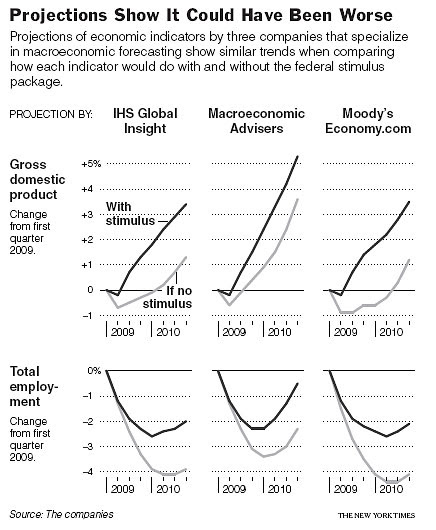
But what about the stimulus money we already spent? Did it work?  Here are three different analysts' opinions:
 So the answer appears to be yes, the stimulus worked as intended. Although it stopped us from falling into a full depression,  it was simply too small for the size of the problem to spur economic growth. 

But what about jobs? It seems like the unemployment rate is still too high. Are we creating any jobs?


So far as job creation goes, it appears that after a few months of 'reduced job losses' immediately after Obama took office, we moved into positive job creation in 2009 and we have since had 27 months of positive job growth.

The economic indicators presented here show that Mitt Romney is making false claims, that in fact President Obama is doing a good job bringing the U.S. economy back after the worst recession we have had since the Great Depression.

Along with the issues that the Tea Party Republicans have shown to be their top priorities, and the half-century of superior economic performance by Democratic Administrations in the White House,  the economic facts presented here clearly show that President Obama deserves a second term.


Wednesday, April 18, 2012

Fiscal Conservatives. Who Knew?

I came across an article at slate.com, with some surprising statistics, showing how well the country has done under Democratic vs Republican administrations in eight economic categories. These cover the period from 1960-2006 (and so don't include the economic collapse of  2008).

These facts will probably surprise many people, because they run  counter to most people’s opinions about the two parties regarding fiscal competence and managing the economy.


From writer Michael Kinsley:

"The figures below are all from the Annual Economic Report of the President (2008), and the analysis is primitive. Nevertheless, what these numbers show, almost beyond doubt, is that Democrats are better at virtually every economic task that is important to Republicans."

"On average, in years when the president is a Democrat, the economy grows faster; inflation is lower; fewer people can't find a job; the federal government spends a smaller share of GDP, whether or not you include defense spending; and the deficit is lower (or—sweet Clinton-years memory—the surplus is higher). The one category that Republicans win is, unsurprisingly, federal taxes as a share of GDP. But it is no trick to lower taxes if you don't lower spending".

1.  GDP  % change (growth)                             Democrats are over 1% better for growth
      Democrats              4.09
      Republicans            2.94
     
2.  Inflation                                                       Inflation is less under Democrats
      Democrats             3.81
      Republicans           4.50

3.  Unemployment                                           Unemployment is lower under Democrats
      Democrats             5.33
      Republicans           6.21
     
4.  Federal Taxes                                             Republicans have less than .5% lower taxes
      Democrats              18.40
      Republicans            17.97
     
5.  Federal Spending                                     Democrats spend over 1% less!  "Tax and Spend Liberals?"   No.
      Democrats              19.60
      Republicans            20.67
     
6.  Deficit                                                       The deficit is over 1.5% less under Democrats!
      Democrats              -1.21
      Republicans            -2.70
     
7.  Defense Spending                                    This one is close, but Democrats spend more on defense, not less.
      Democrats               5.83
      Republicans             5.71
     
8.  Non-Defense Spending                            But for overall spending, Democrats spend less!
      Democrats               13.77
      Republicans            14.96
    
(end of article)
Wow.

It should be noted that there are many factors involved in these results, not the least of which is the makeup of the House and Senate in any particular term.

However, when considering only whether the country has done better with a Republican or a Democrat in office, the results have been totally one-sided in favor of the Democrats, who have proved much better at managing the economy, as well as following the 'conservative principles' of reduced spending and smaller government.

Of course, people don't always vote in concordance with their stated beliefs, and so these results probably won't sway many people who believe the GOP is the party of 'fiscal responsibility' regardless of what the economic statistics show. The term "Cognitive Dissonance" is used to describe the situation when a person holds two or more views that are inconsistent with each other, and we clearly see a good deal of cognitive dissonance in politics, and there's no reason to think this issue will prove any different.

While there may be other legitimate reasons for supporting the GOP, clearly lowering spending, reducing the deficit and increasing growth cannot be among them, as the Democrats have been a full percentage point better at all three.

Although we should remember that correlation does not prove causation, these statistics include a long enough time span and are so solidly in favor of the Democrats, it isn't a fluke or a 'cherry-picked' analysis.  I did not include Mr. Kinsley's chart showing the results if you add a one-year 'buffer' assuming it takes a President a year to put his policies in place, but they show the same results.

These satistics add weight to Rick Santorum's argument that social policy should be the focus of the Republican platform, in that historically the Democrats have now been shown to be better at the managing the economy.  Including the two most recent terms isn't going to alter these figures, President Obama has done a far better job in his three years than President Bush did in his second term (I will be presenting the evidence for this claim in future columns, but considering Bush's second term included the worst recession since the Great Depression, it's not really a difficult claim to prove).

So next time you're sitting around the dinner table, or hanging out at the proverbial water cooler at work, when your favorite Republican brings up the issue of outrageous spending by the Democrats, bust out your iphone and dial up some facts. At least the discussion can then revolve around some evidence rather than the very pervasive myth of Republican superiority in this department.


reference:  http://www.slate.com/articles/news_and_politics/readme/2008/09/politicians_lie_numbers_dont.html